
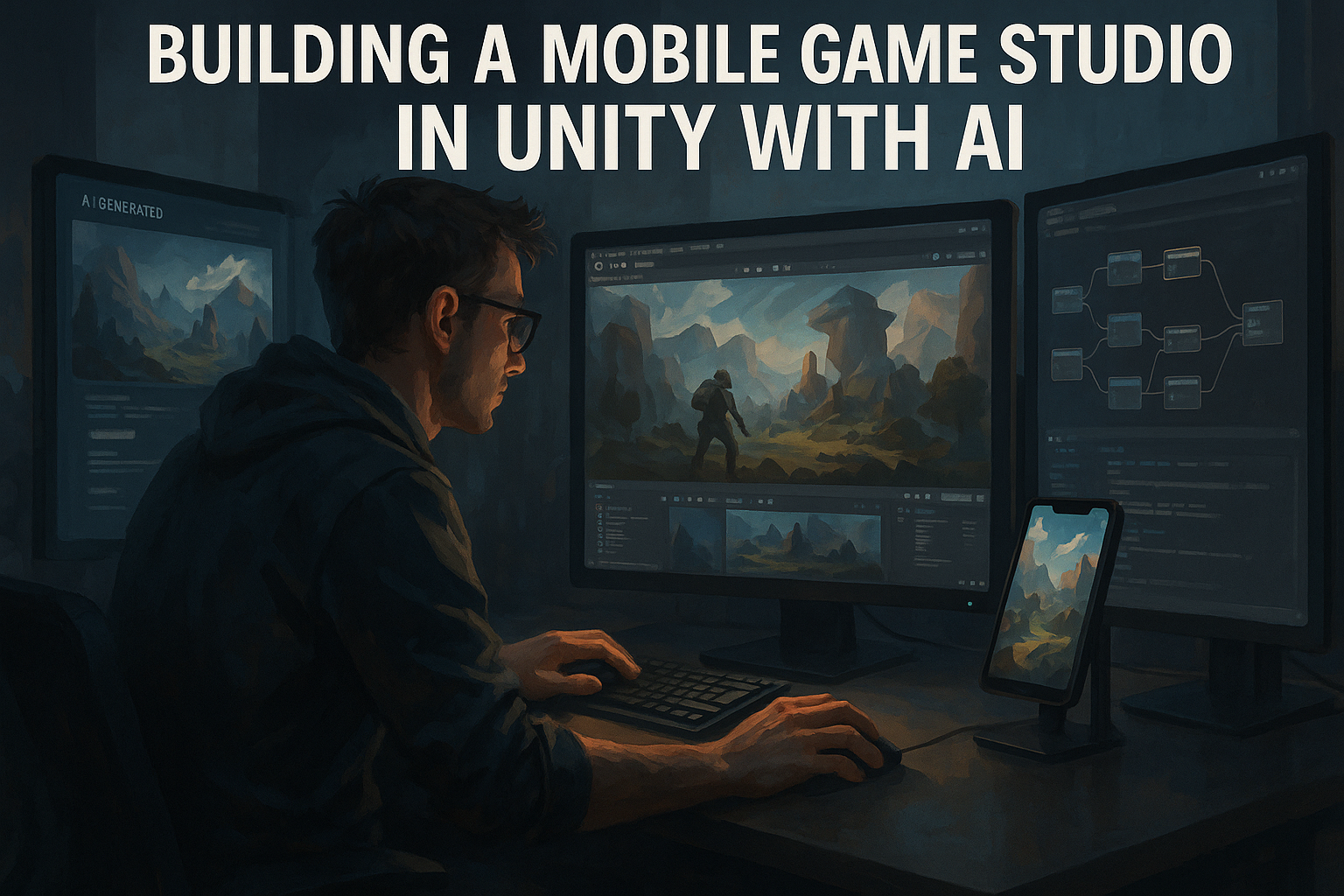
Revolutionizing Mobile Game Development: Mastering Unity, AI Strategies, and Monetization in the Booming 2025 Market
In 2025, mobile game development continues to dominate the gaming industry, offering immense opportunities for creators and studios alike. With platforms like iOS and Android reaching billions of users, tools such as Unity have become essential for building cross-platform experiences. This article explores core Unity concepts tailored for mobile, effective monetization through ads, the strategic advantages of integrating AI like Grok in building a game studio, the current market landscape, and the critical role of mastering top 3D software and AI tools. Backed by reliable data, we’ll provide actionable insights to help you thrive in this dynamic field.

Video Game Development with AI and Unity for Mobile Gaming
The Mobile Gaming Market in 2025: A Lucrative Landscape
The global games market is projected to generate $188.8 billion in revenues in 2025, marking a 3.4% year-on-year growth. Mobile gaming remains the largest segment, expected to surpass $111 billion globally, accounting for over half of all gaming revenue. Some estimates even push this figure to approximately $126 billion by the end of the year, driven by sophisticated smartphones and increasing player engagement. In the U.S. alone, mobile games are forecasted to reach $36.64 billion.
This growth is fueled by a player base of 3.6 billion in 2025, with in-app purchase revenue rising 4% year-over-year and session times up 12%. For aspiring developers, this underscores the potential: mobile games offer accessible entry points, but success demands optimized development and smart monetization to capture a share of this massive market cap.

Examples of popular mobile games built with Unity, showcasing diverse genres and styles.
Core Unity Concepts for Mobile Game Development on iOS and Android
Unity stands out as a versatile engine for mobile development, enabling seamless builds for both iOS and Android. Here are the foundational concepts to master:
- GameObjects and Components: Everything in Unity revolves around GameObjects, which are containers for Components like Transforms (position, rotation, scale), Renderers (for visuals), and Colliders (for physics interactions). For mobile, prioritize lightweight components to maintain performance on varied devices.
- Scripts and C# Programming: Use C# scripts to add behavior. For touch-based inputs on iOS and Android, leverage Unity’s Input System package to handle gestures like swipes and taps efficiently.
- Scenes and Prefabs: Organize your game into Scenes (levels or menus) and use Prefabs for reusable objects, such as enemies or UI elements. This modular approach speeds up iteration for mobile apps.
- Physics and Optimization: Employ Unity’s 2D or 3D Physics engines for realistic interactions. Mobile-specific optimizations include batching draw calls, using occlusion culling, and profiling with Unity’s built-in tools to ensure smooth 60 FPS on lower-end devices.
- UI and Cross-Platform Builds: The Canvas system handles responsive UIs that adapt to different screen sizes. For deployment, Unity’s Build Settings allow easy targeting of iOS (via Xcode) and Android (via APK or AAB files), with plugins for App Store and Google Play integration.
By focusing on these, developers can create engaging titles like those in popular Unity-built games, from casual puzzles to action adventures.

Unity Editor interface demonstrating a simple mobile game scene setup.
Monetizing Mobile Games with Ads in Unity
Ads remain the top monetization strategy for free-to-play mobile games, generating revenue without upfront costs to players. Unity’s integrated Ads platform simplifies implementation, connecting to premium demand sources.
Key strategies include:
- Rewarded Videos: Players watch ads for in-game rewards like extra lives. These yield high engagement and revenue, often integrated via Unity’s Mediation for optimal fill rates.
- Interstitial and Banner Ads: Full-screen interstitials appear at natural breaks, while banners run persistently. Balance placement to avoid disrupting gameplay—Unity recommends testing with A/B splits.
- Hybrid Models: Combine ads with in-app purchases for sustained income. Networks like AppLovin, Unity Ads, and Google AdMob are top performers in 2025.
Successful implementation can boost retention and earnings, as seen in indie titles using these formats to compete in a crowded market.
The Importance of Mastering Top 3D Software and AI Tools
To create compelling mobile games, proficiency in 3D software is crucial for asset creation. Top tools include:
| Software | Key Features | Best For |
|---|---|---|
| Blender | Free, open-source; modeling, animation, rendering | Indie devs; versatile for 2D/3D assets |
| Autodesk Maya | Advanced rigging, simulation; industry-standard | Complex animations and characters |
| Autodesk 3ds Max | Powerful modeling, texturing; integrates with Unity | Architectural environments and props |
Mastering these enhances visual quality, but AI tools amplify efficiency. In 2025, 90% of developers use AI in workflows for content generation and dynamic gameplay. Essential AI tools:
- Promethean AI: For environment building and asset management.
- Replica Studios: AI voice generation for characters.
- Unity ML-Agents: Machine learning for intelligent NPCs.
These tools reduce production time by up to significant margins, enabling faster prototyping and iteration.

Illustration of AI integration across the game development pipeline.
Why Using AI Like Grok is Strategic for Building a Game Studio
Integrating AI like Grok from xAI is a game-changer for studios, offering real-time collaboration, code assistance, and creative ideation. Strategically, it accelerates development by generating scripts, debugging issues, and suggesting optimizations—ideal for Unity projects.
Benefits include:
- Efficiency and Cost Savings: AI handles repetitive tasks like asset generation or story outlining, cutting costs and allowing small teams to scale.
- Innovation: Grok’s access to real-time data inspires unique mechanics, while tools like Grok Studio enable no-code game creation for rapid prototyping.
- Competitive Edge: In a market where AI drives 3D assets and NPCs, studios using Grok can iterate faster, fostering dynamic experiences that boost player retention.
For building a studio, Grok democratizes access, turning ideas into prototypes swiftly and positioning your team in the AI-driven future of gaming.
Conclusion
Mobile game development in 2025 is a blend of technical mastery and strategic innovation. By leveraging Unity’s core concepts, ad-based monetization, and AI like Grok, alongside top 3D and AI tools, you can tap into a market exceeding $100 billion. Start small, optimize relentlessly, and let AI propel your studio to success.